8 responses to “Zen Garden – Three Of The Multitudes Of Variations”
Well executed haiku, Liam. 👏👏👏
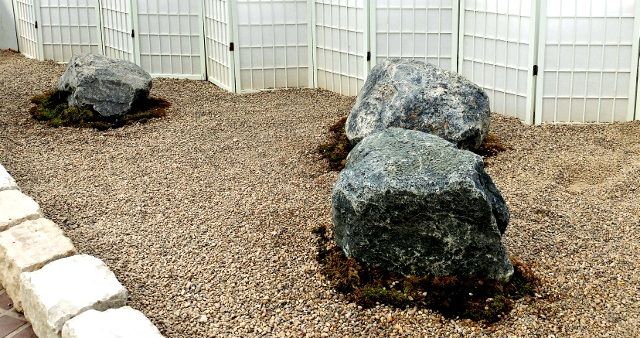
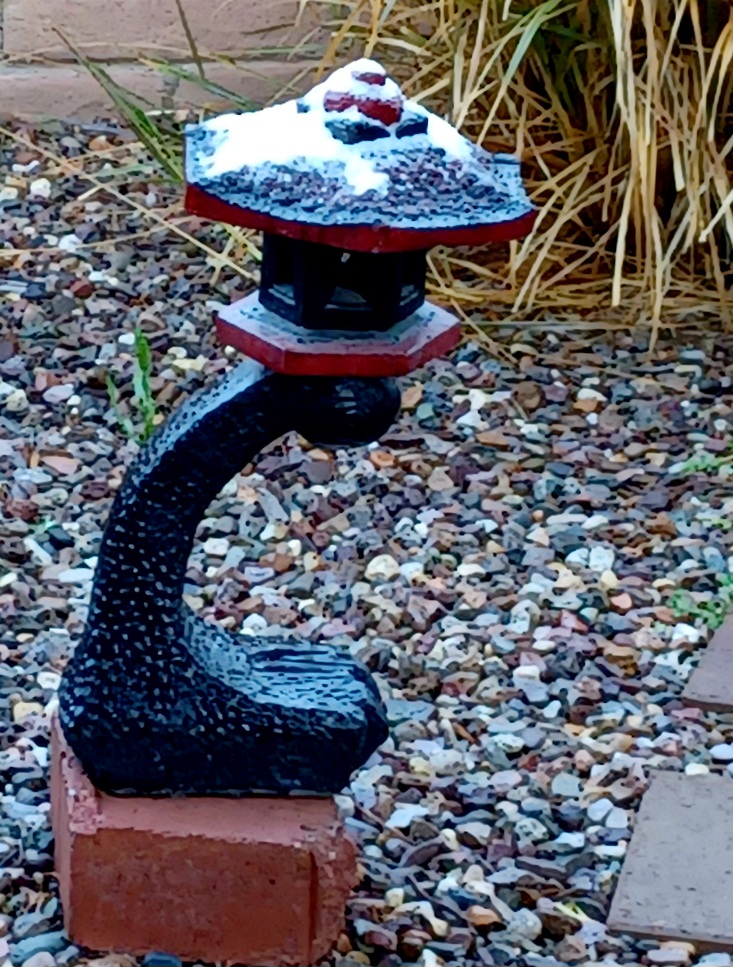
I like the colored stones in yours…looks like a peaceful place to be. I’ve tried to do meditation off and on for years and can’t.
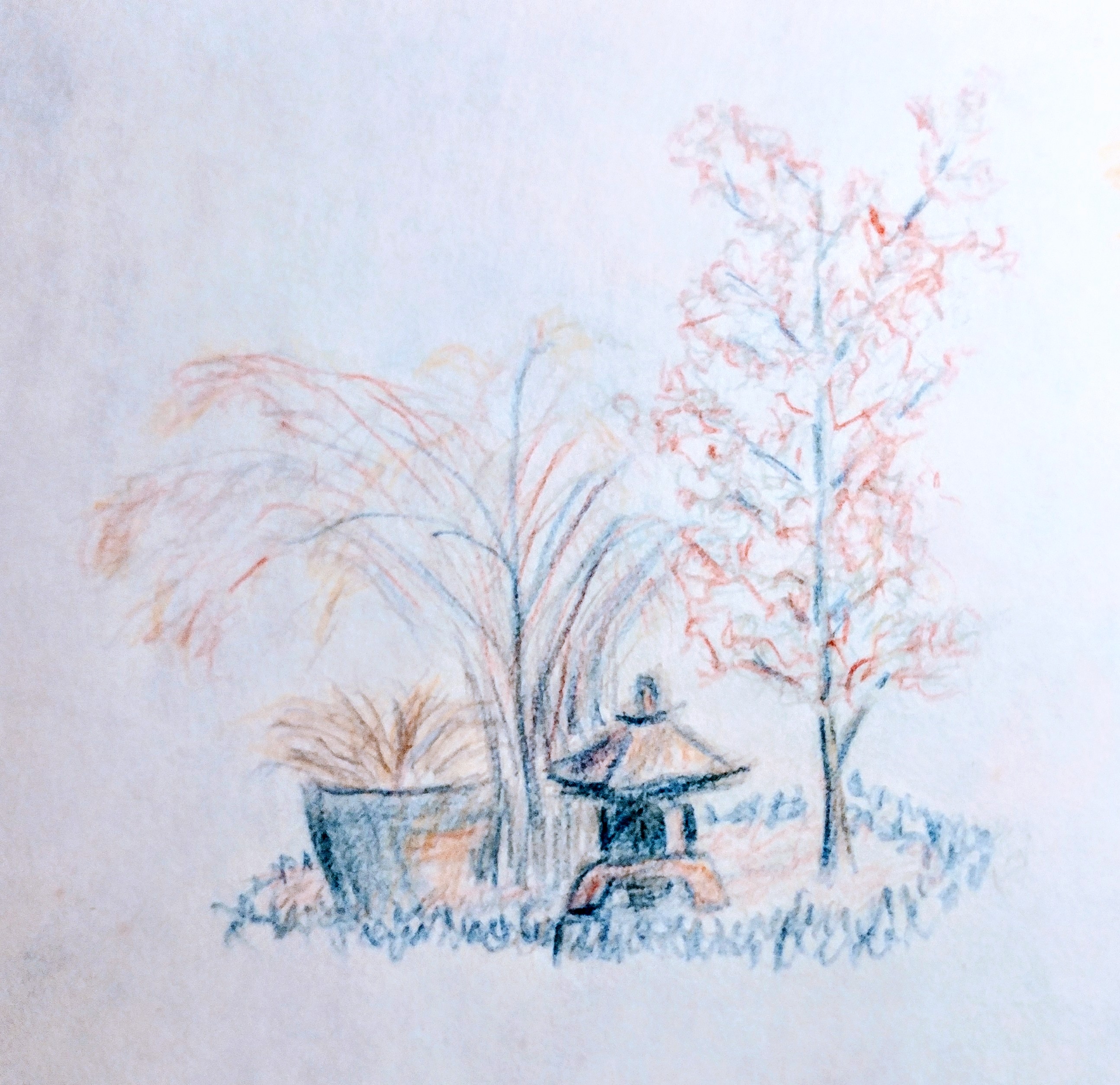
In your colored pencil drawing, what is “K Y” in the caption? Is it an abbreviation for something?
Thanks, Kate; I’m pleased you like it! Yes, KY is for ‘my old Kentucky home’. The spot pictured in my drawing was in our backyard… I spent some creative time setting it up with just the right fountaingrass, a red spit-leaf maple, and black wood mulch rather than gravel and stones… As for meditation… most make it harder than it really is, as it’s a natural function of the mind/body, something one needs to let happen rather than trying to force it… I once wrote an instruction sheet as a quick reference… I may have even posted it here…; -)
Thank you. If I could learn to meditate, maybe it would help my stomach issues. Stress has always played hell with my digestive system, even when I was a young teenager.
Transcendental Meditation (TM) is a technique for quieting the mind, that is, to consciously still the constant internal dialog that we all experience, which seldom abates except during periods of unconsciousness, such as sleep. It is a technique for achieving a purely natural and relaxed frame of mind.
It is not: an out-of-body experience; an altered state of being; past lives regression; self-hypnosis, or any other esoteric, spiritual-metaphysical manifestation.
The following set of simple instructions is for those who would like to give it a try but lack either the money or time commitment necessary for formal classes.
Where to practice
It’s best to practice meditation in a private, quiet, and comfortable place with as few distractions as possible. Outside is fine if there are no or minimal distractions. Some common distractions include: needy pets, cell phone notifications, TV, radio, conversations of others close by, etc.
Posture
Professional instructors will tell you that you must sit in a straight-backed chair or sit cross-legged, with your buttocks on a slightly elevated surface or cushion. This is to keep your back as straight as possible while maintaining the natural curve at the base of your spine. While this is a good practice for your posture, balance, and physical stamina, it is not strictly necessary for successful meditation.
Once you have your setting (place and seated position) for meditation, all that remains is a mantra (at least for TM), one or two syllables (or words) to distract that internal dialog. Typical examples include: OM, one, love, god, joy, good morning, here-now, etc., or make your own up; any will work, depending on your temperament.
Meditate
* Seat yourself comfortably and/or as described above.
* Take a couple of deep cleansing breaths (beneficial, but not necessary).
* Close your eyes and breathe gently while gently and slowly repeating your mantra over and over again until the internal dialog starts slowing down. It may not happen immediately, but will happen more quickly with practice.
* Let your repetition of the mantra slowly dissipate away while gently breathing.
* Start repeating the mantra whenever you realize that you’re in the midst of an internal dialog or just thoughts drifting here and there.
* Repeat these steps for the time you’ve allotted, or you fall asleep, which can happen – and nothing to worry about unless it becomes habitual, in which case sleep is probably needed more than the mediation, at least for the time being.
Coming out of the meditative state
When the time you’ve allotted is finished (usually 15 to 20 minutes, twice daily for beginners is recommended (but any amount of meditation if beneficial) – find a time that works best for you).
* Stop repeating the mantra.
* Slowly start moving, shifting your body.
* Slowly open your eyes (you may need or want to stretch a little).
* Gently return to your ‘normal’ activities.
Final note
All the directives concerning time and posture are suggestions. Don’t let any of them prevent you from giving TM an honest try. If you can’t devote 15 minutes twice a day, no problem. Once a day is better than none a day, etc.
Hope this has been helpful. I’ve been practicing TM and Zazen for many years. Though I’m no ‘master’ nor professional instructor, I was trained in a seminar at Oberlin College in ‘72 by Maharishi-certified instructors. I’ll elaborate on the basics of Zazen in a future instruction sheet.
 CynOp
CynOp 
8 responses to “Zen Garden – Three Of The Multitudes Of Variations”
Well executed haiku, Liam. 👏👏👏
I like the colored stones in yours…looks like a peaceful place to be. I’ve tried to do meditation off and on for years and can’t.
In your colored pencil drawing, what is “K Y” in the caption? Is it an abbreviation for something?
LikeLiked by 1 person
Thanks, Kate; I’m pleased you like it! Yes, KY is for ‘my old Kentucky home’. The spot pictured in my drawing was in our backyard… I spent some creative time setting it up with just the right fountaingrass, a red spit-leaf maple, and black wood mulch rather than gravel and stones… As for meditation… most make it harder than it really is, as it’s a natural function of the mind/body, something one needs to let happen rather than trying to force it… I once wrote an instruction sheet as a quick reference… I may have even posted it here…; -)
LikeLiked by 1 person
If you happen to run across it, if you don’t mind, send me copy. But please, don’t spend a lot of time searching for it.
LikeLiked by 1 person
I’d be happy to, I’ve meant to pull it out for a while now anyway… you’ve given me an excuse to do so…; -)
LikeLiked by 1 person
Thank you. If I could learn to meditate, maybe it would help my stomach issues. Stress has always played hell with my digestive system, even when I was a young teenager.
LikeLiked by 1 person
The Basics of Transcendental Meditation (TM)
Transcendental Meditation (TM) is a technique for quieting the mind, that is, to consciously still the constant internal dialog that we all experience, which seldom abates except during periods of unconsciousness, such as sleep. It is a technique for achieving a purely natural and relaxed frame of mind.
It is not: an out-of-body experience; an altered state of being; past lives regression; self-hypnosis, or any other esoteric, spiritual-metaphysical manifestation.
The following set of simple instructions is for those who would like to give it a try but lack either the money or time commitment necessary for formal classes.
Where to practice
It’s best to practice meditation in a private, quiet, and comfortable place with as few distractions as possible. Outside is fine if there are no or minimal distractions. Some common distractions include: needy pets, cell phone notifications, TV, radio, conversations of others close by, etc.
Posture
Professional instructors will tell you that you must sit in a straight-backed chair or sit cross-legged, with your buttocks on a slightly elevated surface or cushion. This is to keep your back as straight as possible while maintaining the natural curve at the base of your spine. While this is a good practice for your posture, balance, and physical stamina, it is not strictly necessary for successful meditation.
Once you have your setting (place and seated position) for meditation, all that remains is a mantra (at least for TM), one or two syllables (or words) to distract that internal dialog. Typical examples include: OM, one, love, god, joy, good morning, here-now, etc., or make your own up; any will work, depending on your temperament.
Meditate
* Seat yourself comfortably and/or as described above.
* Take a couple of deep cleansing breaths (beneficial, but not necessary).
* Close your eyes and breathe gently while gently and slowly repeating your mantra over and over again until the internal dialog starts slowing down. It may not happen immediately, but will happen more quickly with practice.
* Let your repetition of the mantra slowly dissipate away while gently breathing.
* Start repeating the mantra whenever you realize that you’re in the midst of an internal dialog or just thoughts drifting here and there.
* Repeat these steps for the time you’ve allotted, or you fall asleep, which can happen – and nothing to worry about unless it becomes habitual, in which case sleep is probably needed more than the mediation, at least for the time being.
Coming out of the meditative state
When the time you’ve allotted is finished (usually 15 to 20 minutes, twice daily for beginners is recommended (but any amount of meditation if beneficial) – find a time that works best for you).
* Stop repeating the mantra.
* Slowly start moving, shifting your body.
* Slowly open your eyes (you may need or want to stretch a little).
* Gently return to your ‘normal’ activities.
Final note
All the directives concerning time and posture are suggestions. Don’t let any of them prevent you from giving TM an honest try. If you can’t devote 15 minutes twice a day, no problem. Once a day is better than none a day, etc.
Hope this has been helpful. I’ve been practicing TM and Zazen for many years. Though I’m no ‘master’ nor professional instructor, I was trained in a seminar at Oberlin College in ‘72 by Maharishi-certified instructors. I’ll elaborate on the basics of Zazen in a future instruction sheet.
LikeLiked by 1 person
I have copied your answer and will give it a try in the morning. Thank you, my friend. 😊
LikeLiked by 1 person
My pleasure 😀
LikeLiked by 1 person